Search Results for: Research
First and only full-spectrum Vitamin K2 that provides MK-6, 7 & 9 Ex-NattoPharma further strengthens its reputation as the most comprehensive Vitamin K2 supplier by introducing a breakthrough unlike anything on the market: MenaQ7® Full Spectrum K2. This latest innovation is the result of a proprietary technological breakthrough, creating a Vitamin K2 that provides … Continue reading MenaQ7® K2 Cardio Study Registered
First and only full-spectrum Vitamin K2 that provides MK-6, 7 & 9
Ex-NattoPharma further strengthens its reputation as the most comprehensive Vitamin K2 supplier by introducing a breakthrough unlike anything on the market: MenaQ7® Full Spectrum K2. This latest innovation is the result of a proprietary technological breakthrough, creating a Vitamin K2 that provides menaquinones (MK) 6, 7 and 9, a range of isomers vital for cardiovascular health.
According to ex-NattoPharma, exclusive global supplier of MenaQ7, the only clinically validated and patented Vitamin K2 as MK-7, the important epidemiological studies that led it to its ground-breaking human clinical research used fermented cheese as the source of Vitamin K2, which led to the creation of MenaQ7 Full Spectrum.
According to researchers closely linked to these epidemiological studies: “Vitamin K is a fat-soluble vitamin that plays and unequivocal role in the activation of Gla-proteins. Although all K-vitamins have the same function, they differ in bioavailability and bioactivity … The Rotterdam and Prospect studies have shown that food-derived vitamin K (such as from cheeses) improves long-term cardiovascular health outcomes because it more specifically delivers the long-chain menaquinones MK-4 through MK-10.”
The first and only Vitamin K2 to deliver to deliver a gamut of menaquinone isomers, MenaQ7® Full Spectrum is naturally fermented using chickpea protein, offering an all-trans Vitamin K2 that is free from gluten, soy and all-known allergens, and is suitable for vegans and vegetarians. MenaQ7® Full Spectrum provides the vital menaquinone isomers MK-6, 7 and 9 for optimal and maximal delivery of vitamin K2 with respect to absorption, half-life and biological activity.

Clinical single-arm trial with renal transplant recipients shows improved arterial stiffness A new study of renal transplant recipients, a group shown to express subclinical vitamin K deficiency, examined whether K2 supplementation would correct this deficiency and thus improve arterial stiffness. The study has published in Journal of the American Society of Hypertension, and the … Continue reading New Study Confirms MenaQ7® Inhibits Artery Hardening
Clinical single-arm trial with renal transplant recipients shows improved arterial stiffness
A new study of renal transplant recipients, a group shown to express subclinical vitamin K deficiency, examined whether K2 supplementation would correct this deficiency and thus improve arterial stiffness. The study has published in Journal of the American Society of Hypertension, and the vitamin K2 used in the study was MenaQ7® Vitamin K2 as MK-7 from ex-NattoPharma.
This Lebanese study evaluated in the KING trial (a single-arm pilot study) to see if there is an association between vitamin K2 supplementation and the change in both subclinical vitamin K status and indices of arterial stiffness among 60 renal transplant recipients with stable graft function. The results showed that 8 weeks of MK-7 supplementation (360 mcg/day as MenaQ7®) was associated with significant improvement in arterial stiffness and 24-hour peripheral and central pressures. The mean reduction in cfPWV was 1.4 m/s, which was well beyond the reduction of 1 m/s recommended for a clinically relevant vascular effect.
After just 8 weeks of MK-7 supplementation, low vitamin K status (represented by dpucMGP level) was significantly reduced by 55.1%. Moreover, supplementation was associated with a 14.2% reduction in mean cfPWV.
In addition, MK-7 supplementation improved vitamin K status, which was represented by the reduction in dp-ucMGP concentrations. A positive correlation was present between the reduction in arterial stiffness, a surrogate of early cardiovascular disease, and the circulating concentration of dp-ucMGP, a marker of subclinical vascular vitamin K deficiency and calcification.
The main conclusion was that, among renal transplant recipients with stable graft function, vitamin K2 supplementation was associated with improvement in subclinical K deficiency and arterial stiffness. According to the researchers, the findings from this trial support the hypothesis that subclinical vitamin K deficiency may be a modifiable cardiovascular risk factor and may improve with MK-7 supplementation.
Reference:
Mansour AG et al. Vitamin K2 supplementation and arterial stiffness among renal transplant recipients – a single-arm, single-center clinical trial. J Am Soc Hypertens. 2017 Jul 13. Pii: S1933-1711(17)30255-3.

The only Vitamin K2 shaped strictly by data confirming true health benefits: MenaQ7®
Being able to say an ingredient is clinically validated takes an overwhelming investment and commitment, which is the exact course that has shaped the MenaQ7® Vitamin K2 as MK-7 on the market today.
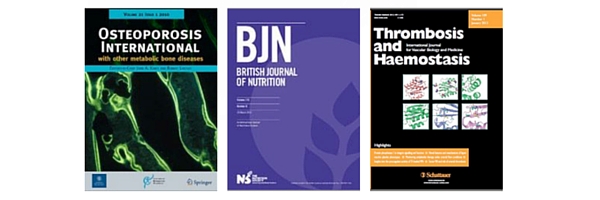
Today’s understanding of Vitamin K2 is based solely on MenaQ7®, the source material for more than 22 human clinical trials (with more underway) demonstrating safe, efficacious benefits for human health. And those studies were published in respected peer-reviewed journals:
MenaQ7® and Cardiovascular Health
- Vermeer C and Vik H. Vascular Diseases and Therapeutics. 2020
- Mansour et al. Journal of the American Society of Hypertension. 2017
- Aoun et al. BMC Nephrology. 2017
- Knapen et al. European Journal of Clinical Nutrition. 2016
- Knapen et al. Journal of Nutritional Science. 2015
- Kurnatowska et al. Polish Archives of Internal Medicine. 2015
- Knapen et al. Thrombosis and Haemostasis. 2015
- Theuwissen et al. British Journal of Nutrition. 2012
- Chatrou et al. Blood Review. 2012
- Dalmeijer et al. Atherosclerosis. 2012
MenaQ7® in Diseased Populations
- Mansour et al. Journal of the American Society of Hypertension. 2017
- Aoun et al. BMC Nephrology. 2017
- Kurnatowska et al. Polish Archive of Internal Medicine, 2015
- Calwue et al. Nephrology Dialysis Transplant. 2014
- Ozdemir et al. Journal Pediatric Hematology Oncology. 2013
- Westenfeld et al. American Journal of Kidney Disease. 2012
MenaQ7® in Healthy Populations and Children’s Health
MenaQ7® for Optimal Bioavailability
This commitment to scientific research and clinical validation has earned MenaQ7® the VitaK2™ Seal of Quality and Efficacy from the world’s leading experts in vitamin K.
MenaQ7® is featured in quality products around the globe.

Knapen et al. published the first double-blind, randomized, intervention trial where the results confirm that Vitamin K2 intake is linked to cardiovascular risk. Researchers found that, after three years of daily supplementation with 180 mcg Vitamin K2 as MK-7 (as MenaQ7®), it not only inhibited age-related stiffening of the artery walls, but also made a statistically significant improvement of vascular elasticity, especially in women having high arterial stiffness. To date, the effects of increased menaquinone intake on markers of vascular health have been investigated using predominantly food supplements. Therefore, Knapen et al. sought to study the effects of a menaquinone-fortified yogurt drink (as MenaQ7®) on vitamin K status and markers of vascular health in healthy men and postmenopausal women. Results showed MK-7 was efficiently absorbed from the fortified yogurt drink, improving vitamin K status, which contributed to improved cardiovascular health.

Knapen et al. published the first double-blind, randomized, intervention trial where the results confirm that Vitamin K2 intake is linked to cardiovascular risk. Researchers found that, after three years of daily supplementation with 180 mcg Vitamin K2 as MK-7 (as MenaQ7®), it not only inhibited age-related stiffening of the artery walls, but also made a statistically significant improvement of vascular elasticity, especially in women having high arterial stiffness.
To date, the effects of increased menaquinone intake on markers of vascular health have been investigated using predominantly food supplements. Therefore, Knapen et al. sought to study the effects of a menaquinone-fortified yogurt drink (as MenaQ7®) on vitamin K status and markers of vascular health in healthy men and postmenopausal women. Results showed MK-7 was efficiently absorbed from the fortified yogurt drink, improving vitamin K status, which contributed to improved cardiovascular health.
MenaQ7® products align with clean label principles: providing a pure, active ingredient with few natural inerts like oils and powders
MenaQ7® Solutions are developed with a “Better for You” principle :
- Vegan-Friendly • Free from sugar
- Non- GMO Project Verified • Free from gluten
- Certified Kosher & Halal • Free from allergens
- Free from pesticides and toxins
MenaQ7® is produced to meet the most stringent quality assurance measures.

cGMP
MenaQ7® adheres to current Good Manufacturing Practices. GMP describes the conditions and practices that are necessary for the processing, packing, or storage of food to ensure its safety and traceability.

iso22000
This International Standard specifies the requirements for a food safety management system that combines the following recognized 4 key elements to ensure food safety along the food chain, up to the point of final consumption:
- Interactive communication;
- System management;
- Prerequisite programmes; and
- HACCP principles.

Sef-affirmed GRAS
In the U.S., MenaQ7® is Generally Recognized as Safe (GRAS), a designation by the U.S. Food and Drug Administration (FDA) stating that all necessary research, including the formation of an expert panel to review safety concerns, has been performed.

Non GMO
In the U.S., MenaQ7® is Generally Recognized as Safe (GRAS), a designation by the U.S. Food and Drug Administration (FDA) stating that all necessary research, including the formation of an expert panel to review safety concerns, has been performed.

Novel Food
Novel Food is defined as food that has not been consumed to a significant degree by humans in the EU prior to 1997, when the first Regulation on novel food came into force. ‘Novel Food’ can be newly developed, innovative food or food produced using new technologies and production processes, as well as food traditionally eaten outside of the EU.

Halal
MenaQ7® products are not made form ingredients derived from animals.

Kosher
MenaQ7® is not made from ingredients derived from animals or any non-Kosher plant or fruit part.

Suitable for Vegans and Vegetarians
Products are not manufactured with any raw material or processing aids of animal origin.
The MenaQ7® product range has evolved over the years thanks to the pioneering of new technologies:

MenaQ7®
A Vitamin K2 derived by natural fermentation, completely free from known allergens, backed by published studies demonstrating improvements in bone and cardiovascular health, enabling strong product positioning and differentiation. MenaQ7® is:
- Non-GMO Verified
- Vegan Friendly
- Halal & Kosher Certified
- Gluten Free
- All-transMK-7
With an unquestionable pedigree of clinical validation, MenaQ7® supports strong product positioning and differentiation for industry brands:
- Enable your product to stand out on crowded shelves with a quality, branded ingredient.
- Enjoy the confidence of making structure-function claims based on MenaQ7® K2’s proven benefits.
- Earn Consumer appreciation and loyalty — “Proof That It Works” is the No. 1 consumer selection criteria!

MenaQ7® Matrix
Ensuring the stability of menaquinone ingredients can be complicated as brand owners conceive of more complex formulations. Research shows that moisture and mineral salts are critical variables for degradation, driving the need for a protective technology to shelter the menaquinone molecules during shelf life. Enter MenaQ7® Matrix: the clinically proven health benefits of MenaQ7® delivered via an award-winning Vitamin K2 Matrix protective technology.
This latest innovation is the result of a proprietary technology that protects the particles of MK-7 with no coating, no additives, and no additional ingredients, making it a true clean-label alternative for formulators. It also eases the process of complex formulations, allowing products to hit the market faster while providing cost-effective manufacturing.
MenaQ7® Vitamin K2 as Manaquinone-7 (MK-7) Facts
- Dispersible Formats
- Mineral Combinations
- Liquids
- Chewable Tablets
- Functional Foods
- Tablets
- Soft Gels
For more information on the range of MenaQ7® dilutions and solubilities, and how this comprehensive offer can add value to your finished product :